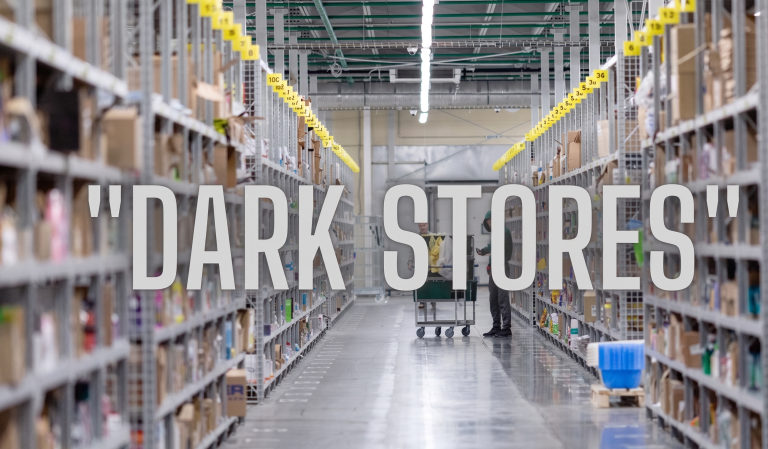
You have never walked into a dark store. Nobody has. That’s precisely the point.
A dark store is a compact warehouse — typically 2,500 to 4,000 square feet — built exclusively to fulfil online orders. No signboards, no walk-in customers. Just shelves, pickers, and delivery partners optimised for a single metric: getting an order to your door within 10 to 30 minutes.
Across India, this model isn’t just growing — it is reshaping urban real estate. And if national data is any guide, Eastern India stands at the cusp of a significant commercial transformation it has barely begun to notice.
The Numbers That Demand Attention
India’s q-commerce market reached approximately ₹64,000 crore in FY25, growing at a CAGR of 142% between FY22 and FY25. According to HSBC Global Research, the sector is expected to operate 5,000–5,500 dark stores by FY26, with gross order value projected at $35–40 billion by FY28. The demand for dark store space reached 24 million square feet in 2023 and, according to a joint study by JLL and Miebach Consulting, is projected to grow at a CAGR of 12%, reaching 37.6 million square feet by 2027.
The major operators are building at scale. Blinkit now operates around 2,100 dark stores nationwide. Swiggy Instamart and Zepto each have around 1,100–1,200. Reliance Retail has scaled its dark store operations to over 600 locations.
What Dark Stores Are Doing to Property Values
Dark stores are quietly transforming formerly underutilised commercial spaces. “Vacant retail spaces are being transformed into dark stores, maintaining occupancy rates in commercial properties and providing e-commerce companies with prime delivery locations,” said Balbir Singh Khalsa, Executive Director of Industrial Capital Markets at Knight Frank India. For landlords, dark stores generate rental income ranging from ₹40 to ₹200 per square foot per month, according to Savills India Research.
The economics are straightforward: dark store tenants sign longer leases, pay reliably, and expand aggressively. For landlords struggling with post-pandemic retail vacancies, this represents a meaningfully more stable income stream.
Eastern India: The Emerging Frontier
Against this national backdrop, Eastern India presents an opportunity that is arguably underappreciated.
Kolkata currently sits in the ₹40–₹80 per square foot per month rent band — the same range that characterised Chennai, Hyderabad, and Pune before their dark store markets matured. Delhi now commands ₹150–₹250; Mumbai ₹80–₹150. The trajectory is clear.
Kolkata’s dense urban wards — from Shyambazar and Ultadanga in the north to Ballygunge and Gariahat in the south — contain exactly the kind of compact, high-footfall residential-commercial localities that dark stores require. Howrah, Salt Lake, New Town, and the urbanising corridors of South 24 Parganas add further addressable geography. Localities like Dum Dum, Behala, Tollygunge, Barasat, and Barrackpore hold significant inventories of underutilised ground-floor commercial space that is structurally well-matched to dark store requirements.
Beyond Kolkata, cities like Bhubaneswar, Guwahati, Patna, and Ranchi are seeing rapid digital adoption — India had over 1.12 billion mobile connections and 806 million internet users as of early 2025 — the foundational prerequisite for q-commerce growth.
Challenges to Navigate
The opportunity is real but not friction-free. Regulatory grey zones between residential and commercial land-use classifications, fire NOC compliance, and delivery-partner traffic in residential localities remain genuine friction points. Entering now — before rental pressures peak — is the Eastern market’s key advantage.
The Window Is Still Open
Blinkit, Swiggy Instamart, and Zepto are already active in Kolkata. In Mumbai and Delhi, the dark store real estate opportunity has been substantially priced in. In Bengaluru and Hyderabad, the process is advanced.
In Kolkata, Bhubaneswar, Guwahati, and Patna, the window remains open.
The density is there. Consumer behaviour is shifting. The operators are arriving. The only question is whether property owners in this region will recognise the opportunity before the market does it for them.
The doors are shuttered. The opportunity inside is not.
[Sources:
moneycontrol https://www.moneycontrol.com/news/business/real-estate/quick-commerce-boom-to-fuel-india-s-dark-store-surge-network-to-triple-to-7-500-by-2030-13739193.html
kotakneo.com
https://www.kotakneo.com/investing-guide/articles/how-dark-stores-are-changing-indian-real-estate/
HSBC Global Research (via Entrepreneur India, January 2025) Source for: 5,000–5,500 dark stores expected by FY26; $35–40 billion GOV projected by FY27–28 URL: entrepreneur.com/en-in]