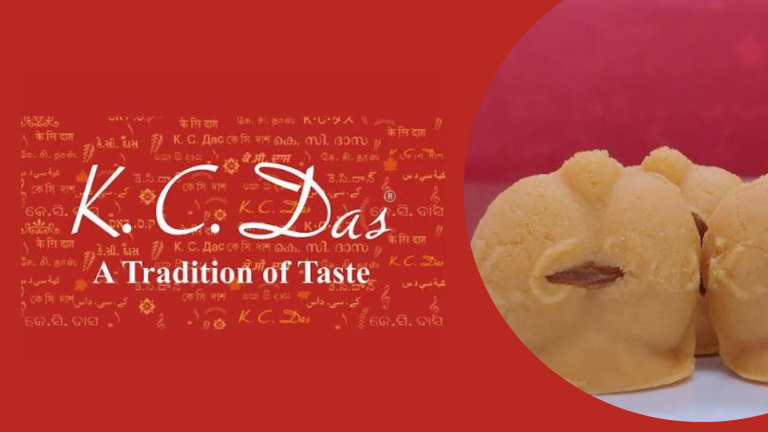
There are brands that sell products. And then there are brands that shape culture. K.C. Das belongs firmly in the second category — a Kolkata sweet shop whose legacy stretches across 150 years, two invented sweets, and a canning innovation that took Bengal’s most iconic dessert to the world before refrigeration made it easy.
The story begins not with K.C. Das himself but with his father, Nobin Chandra Das, who invented the rosogolla in 1868 from his small shop in Bagbazar, Kolkata. What Nobin Chandra created, his son Krishna Chandra Das — born in 1869 — industrialised, expanded, and immortalised.
The Inventor Behind the Brand
Krishna Chandra was not merely a confectioner who inherited a successful shop. He was an innovator. In 1930, he opened his first establishment, Krishna Chandra Das Confectioner, at Jorasanko — and from that address he launched two contributions that would define Bengali sweet culture permanently.
The first was Rossomalai, a creation entirely his own, which has since become one of the most beloved Bengali sweets nationally and internationally. The second was arguably more significant from a commercial and historical standpoint — the canned Rosogolla. Krishna Chandra introduced the first and only canned dessert manufactured in India at the time, a logistical breakthrough that allowed Bengal’s most iconic sweet to travel across borders and reach Bengali diaspora communities across the world, long before modern cold chain infrastructure existed.
It is owing to the pioneering efforts of the Das family, as their own records state, that the Rosogolla may fairly be regarded as the national sweet of India. That is not marketing language. It is a claim backed by over a century of cultural and commercial evidence.
The Legacy Continues
Krishna Chandra passed away within four years of opening his Jorasanko shop, leaving the business in the hands of his son Sarada Charan Das — a man who had begun his career as a research assistant to Nobel Laureate Dr. C.V. Raman between 1926 and 1930. In 1946, K.C. Das was incorporated as a private limited company under the Companies Act, with Sarada Charan as its founding Governing Director.
Under Sarada Charan, the company underwent significant modernisation. He designed an entirely steam-based, environment-friendly production technology that was deployed across all the company’s factories — a system that enabled K.C. Das to meet national standards and match international benchmarks for food safety and hygiene. The cottage technology of Nobin Chandra’s 1868 shop had, through three generations of the Das family, morphed into a modern food company without losing the integrity of the original product.
What K.C. Das Means for Bengal
Today K.C. Das operates multiple outlets, sells nationally and internationally through its online platform, and continues to produce its full range of sweets using mechanised processes designed to preserve quality at scale. The product range spans Syrupy Sweets, Sandesh, Fried Sweets, Nolen Gur Specials, Diabetic Sweets, Doi, Snacks, and Beverages — a portfolio that has evolved while remaining rooted in the Bengali sweet tradition.
But what K.C. Das represents for Bengal goes beyond its product list. In an era when regional food brands are routinely acquired, diluted, or outcompeted by national FMCG players, K.C. Das has remained in family ownership across five generations, maintained its original production philosophy, and continued to carry the cultural weight of being the house that gave India its rosogolla.
For a brand rooted in Bagbazar — one of Kolkata’s oldest and most culturally significant neighbourhoods — to have survived, modernised, and remained relevant across 150 years is an achievement that no marketing budget can manufacture.
Some brands outlast their era. K.C. Das outlasted several.
Sources: K.C. Das official website (kcdasonline.com), East India Retail heritage brands series.