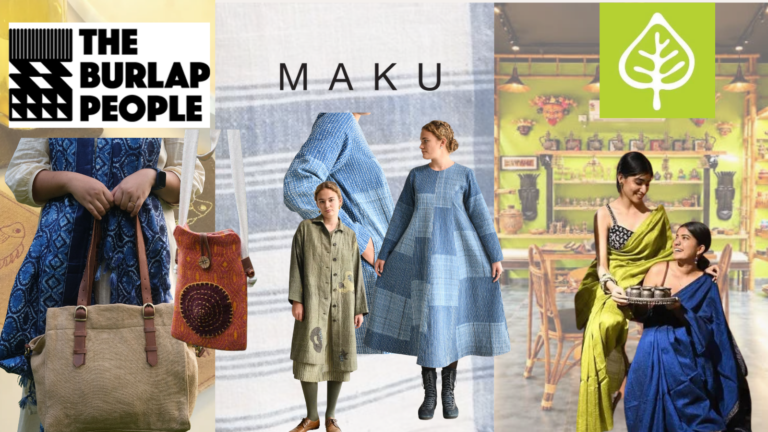
Eastern India’s sustainability story keeps unfolding, one artisan community at a time. This instalment turns to three Bengal-rooted names — The Burlap People, Maku Textiles, and Deshaj India — each built around a different material and mission, yet united by one belief: slow, handmade, and locally sourced isn’t a limitation, it’s the point.
The Burlap People — Making Jute Cool Again
For Samriddh Burman, this label was less a choice than an inheritance. His family has exported jute bags out of Calcutta for over 40 years, and The Burlap People began as an offshoot of that business before finding its own voice. Burman’s pitch was simple: the material didn’t need reinventing, just better design.
Every bag is handcrafted from biodegradable jute, natural cotton, and occasionally salvaged leather, made by third and fourth-generation craftspeople rather than a factory line. The label’s recent Stripes and Calcutta collection reimagined the city’s iconic baajar bag, printed by one of India’s oldest screen-printing units — a reminder that for Burman, heritage and craft were always the same story.
Maku Textiles — Handloom as a Political Statement
Maku isn’t just a clothing label — for founder Santanu Das, a National Institute of Design graduate who returned to India after working in New York, it’s closer to an extension of his artistic practice. Das built the brand around a single dye, indigo, which in Bengal carries a complicated history he leans into rather than smooths over.
Every garment is handspun, handwoven, and hand-dyed using organically produced textiles — no synthetic shortcuts for a colour that depends on yield, climate, even bacteria to form. Maku has worked closely with jamdani brocade weavers of West Bengal for over a decade, and deliberately embraces visible imperfection — reverse buttons, uneven print — as a quiet rebuttal to fast fashion’s demand for uniformity.
Deshaj India — Turning Craft Into Livelihood
Deshaj takes a different route to sustainability — one that starts with policy, not product. It’s an initiative of the West Bengal Scheduled Castes & Scheduled Tribes Development & Finance Corporation, facilitated by AIM (Art Illuminates Mankind), a welfare organisation working with nearly 50,000 artisans across India. The brand was built to convert that reach into something lasting: real livelihood for rural and tribal craftspeople.
Every month, Deshaj runs training programmes with designers and craft experts, helping artisans — many of them women from marginalised communities — sharpen their skills and join its growing network. Spanning weaving, embroidery, and traditional handicrafts, Deshaj treats market access as the missing piece of the sustainability puzzle: a craft only survives if the people making it can afford to keep doing so.
Why This Matters?
The Burlap People’s jute craft, Maku’s patient indigo, and Deshaj’s livelihoods mission look nothing alike on paper — a family business, a designer’s art project, a state-backed initiative. What unites them is a shared refusal to let speed and scale come before craft and community.
Sources: East India Retail, The Burlap People (theburlappeople.com), Maku Textiles (makutextiles.in), Deshaj India (deshajindia.com).