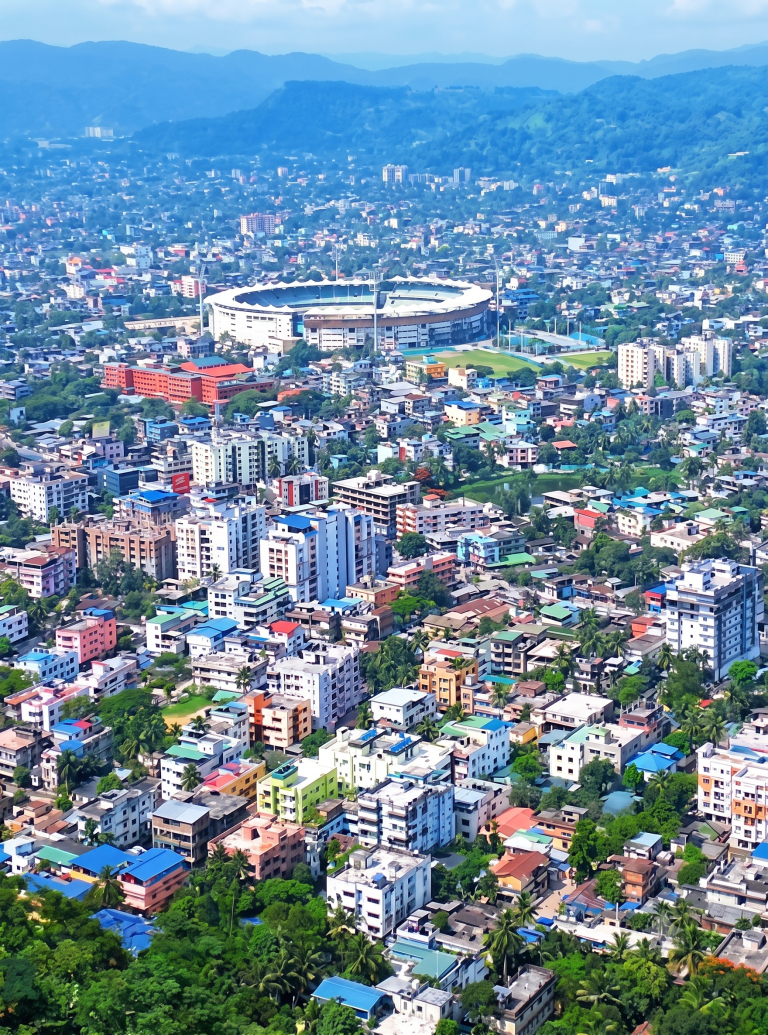
There is a quiet but definitive shift underway in India’s retail geography. While conversations about emerging markets have long centred on Pune, Ahmedabad, or Lucknow, a city in the far east is rewriting that story. Guwahati, the commercial capital of Assam, is no longer simply a transit point connecting the mainland to the eight northeastern states. It is fast becoming the anchor of organised retail across a region of over 50 million people — and the numbers are beginning to reflect what ground realities have long suggested.
The most telling signal came from Knight Frank India’s Think India Think Retail 2024 report. Among all 58 high streets tracked across 29 cities in the country, the Guwahati-Shillong Road recorded the highest rent appreciation of 38 percent in 2023 — the highest not just among Tier 2 cities, but across all high streets nationally. That is not a statistic you associate with a market that brands have historically overlooked. It is the statistic of a market that has been underserved for too long and is now correcting sharply.
The Infrastructure Shift That Made It Possible
Guwahati’s retail story cannot be told without its infrastructure story. For decades, the Northeast’s geographical isolation — surrounded by international borders and connected to the mainland through the narrow Siliguri Corridor — made logistics expensive and brand expansion tentative. That constraint is being systematically dismantled.
A JLL report has identified game-changing infrastructure projects accelerating market transformation in Guwahati, including a 93-kilometre Ring Road set for completion by 2026 that will decongest the urban core while unlocking development potential in the Azara, Baihata, and Narengi corridors. A 6-lane Guwahati-North Guwahati Bridge is also set to reduce cross-river travel time from an hour to 15 minutes, boosting development on the north bank. The Lokpriya Gopinath Bordoloi International Airport has been expanded to a 10-million-passenger capacity. Each of these projects has a direct implication for retail — shorter transit times, wider catchment areas, and easier inventory movement in and out of the city.
The Act East Policy, driven through the Ministry of Development of North Eastern Region, has provided the overarching policy framework for this infrastructure push, realigning supply chains and reducing the cost premium that long made Northeast India a difficult retail bet.
The result is a city that now functions as a redistribution hub for the entire region. Shoppers from Meghalaya, Arunachal Pradesh, Nagaland, and Upper Assam regularly travel to Guwahati for purchases they cannot make at home. This floating catchment population is a critical variable that brands and real estate developers must factor into their Guwahati calculus — the market is larger than the city’s own population suggests.
The Real Estate Corridors
GS Road is Guwahati’s retail spine and its most closely watched commercial corridor. Most of the city’s top malls — City Centre, Dona Planet, Hub Mall, and Guwahati Central — are clustered on or near GS Road. Hub Mall holds the distinction of being Guwahati’s first modern mall, having pioneered organised branded retail in the city, while City Centre has emerged as the address for premium and aspirational brands. Shoppers Stop, Nykaa Luxe, and Adidas have all established presence at City Centre, reflecting the appetite for lifestyle retail that the market now sustains.
Beyond the malls, GS Road itself has evolved into a premium high street corridor — and it is this high street, not just the mall supply, that drove the record rental appreciation flagged by Knight Frank. The supply of Grade-A retail space, however, remains constrained relative to demand. This gap is both a challenge and an opportunity. For developers willing to commit to well-designed, institutionally managed retail assets in Guwahati, the demand-side fundamentals are as strong as in many Tier 1 cities.
According to JLL’s report Beyond the Metros: Insights into India’s Emerging Real Estate Stars, Guwahati represents one of India’s most compelling real estate investment opportunities, with total office stock projected to rise 80 percent from 2 million square feet in 2024 to 3.6 million square feet by 2027. While this headline figure covers office space, the broader point is that Guwahati’s commercial real estate market is entering a phase of structural supply expansion — one that will inevitably carry retail real estate along with it.
The Brand Entry Wave
Reliance Retail’s fashion format AZORTE, which has been a forerunner in tech-driven retail, recently opened a store in Guwahati as part of a rapid national expansion. This is part of a broader pattern of national brands treating Guwahati not as a peripheral market but as a priority in their Northeast strategy. Red Tape has opened on GS Road near Paltan Bazaar. Zudio, which opened 203 new stores in FY2024 alone and entered 46 new cities, has been active in the Northeast. QSR chains, beauty retailers, and lifestyle brands have been steadily building presence across the city’s malls and high streets.
The consumer driving this expansion is not who the national retail industry once assumed. At the RAI North East Retail Summit 2026 held in Guwahati, industry leaders noted that e-retail penetration in the region already runs 1.2 times the national average, and that Korean beauty and fashion influence represents a documented shift in how the Northeast consumer defines aspiration. Kumar Rajagopalan, Executive Director and CEO of the Retailers Association of India, described the Northeast as a rapidly evolving consumption market with distinct consumer preferences shaped by global influences and local diversity. The conservative Tier 2 consumer stereotype does not hold in Guwahati. This is a market that is fashion-conscious, digitally engaged, and aspirationally aligned with Tier 1 consumption patterns — while retaining a strong sense of regional identity that rewards brands which localise seriously.
The Challenges That Remain
None of this should obscure the genuine structural challenges that persist. Land acquisition in Guwahati remains complicated by a combination of municipal regulations and topographical constraints, which raises construction costs and slows the pace of new Grade-A retail supply. Flood vulnerability — the city sits on the Brahmaputra flood plain — introduces periodic disruption to retail operations and complicates long-term real estate planning. Traffic congestion on GS Road, particularly during peak hours, has been a persistent deterrent to consistent footfall. And while Guwahati anchors the regional catchment, the markets immediately beyond it — in Shillong, Dimapur, Agartala — remain significantly smaller and harder to service profitably.
Logistics costs from the mainland, while falling, have not yet reached parity with Central or Western India. For brands managing tight inventory cycles, this continues to be a margin consideration that shapes expansion decisions.
The Five-Year Outlook
The trajectory, however, is clear. The RAI North East Retail Summit, now in its fourth edition, has emerged as a key platform reinforcing the region’s growing importance in India’s retail landscape, with discussions at the 2026 edition focusing on regional market dynamics, localisation strategies, and opportunities for organised retail expansion across all seven northeastern states. The fact that this summit is now in its fourth year, and attracting participation from developers, national retail chains, and real estate consultants, signals institutional recognition of the market’s maturity.
Over the next five years, the completion of the Ring Road and the expanded airport capacity will accelerate Guwahati’s transformation from a primary shopping destination for Assam into a genuine regional retail metropolis. Mixed-use developments integrating retail, entertainment, and hospitality will define the next wave of supply. Omnichannel integration — already reflected in the region’s above-average e-retail penetration — will become a table-stakes expectation rather than a differentiator.
For brands yet to enter, the window for first-mover advantage is narrowing. For developers with the appetite to build institutional retail assets in an undersupplied market with strong fundamentals, Guwahati offers a case that is difficult to argue with. And for the retail industry at large, it offers a reminder that India’s next growth chapter will not be written in the metros alone.
[Sources: Knight Frank India Think India Think Retail 2024, JLL India Beyond the Metros 2025, Retailers Association of India North East Retail Summit 2026, Assam Tribune, Fashion Value Chain.
Image: Google Images]