The first part of this series explored how Boroline and Sreeleathers turned colonial-era origins into modern business powerhouses. The story does not end there. Bengal’s heritage brand landscape runs deeper — across sweet shops, snack factories, umbrella workshops, and spice houses — and several of those stories deserve the same attention. Here are four more.
1.K.C. Das — The Sweet Shop That Went Global Before Global Was a Word
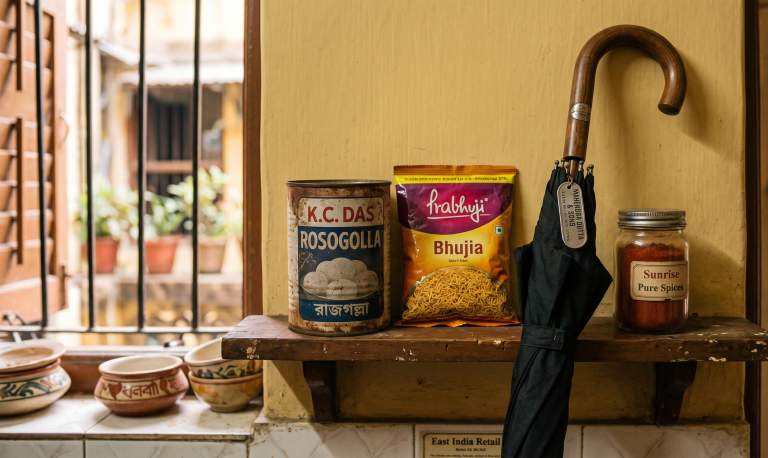
Krishna Chandra Das, born in 1869 in Bagbazar, Kolkata, was the son of Nobin Chandra Das — the man credited with inventing the rosogolla in 1868. Where his father created the sweet, K.C. Das industrialised it. He invented rasmalai and introduced the concept of vacuum-sealed canned rosogolla, effectively globalising Indian sweets through export at a time when refrigeration was not a viable option for cross-border distribution. The canned rosogolla was not just a product innovation — it was a logistical breakthrough that took Bengal’s most iconic sweet to Bengali diaspora communities across the world.
Today, under the fifth-generation stewardship of director Dhiman Das, K.C. Das Confectionery has grown to over 25 locations across major Indian cities including Kolkata and Bengaluru, with new outlets opening as recently as 2025, and annual revenues of approximately Rs 22.6 crore in fiscal year 2024. The brand name is written in 22 languages across its outlets — a deliberate statement that K.C. Das belongs to all of India, not just Bengal.
Fun fact: K.C. Das ran a newspaper advertisement on August 15, 1947 — the day India became independent.
2.Mukharochak — Bengal’s Original Snacking Brand
Long before Haldiram’s became a household name across India, Bengali households were already reaching for a different packet at tea time. Mukharochak Chanachur started in 1950 at the production and sale counter of Tollygunge Tram Depot and soon became a fixture in every Bengali home with the tagline “Anytime Tasty,” retaining its spicy, tangy, and crunchy ethnic flavour without diluting it for broader markets.
The Chandra family, who built the brand, eventually took it from a tram depot snack counter to a nationally certified food company. Under Pranab Chandra, Mukharochak became an ISO 9001:2008 and ISO 22000:2005 certified company, operating a modern hi-tech plant with fully automated, four-layer nitrogen-filled packaging, and expanded its product range to include tiffin snacks, ethnic snacks, tea snacks, and cocktail snacks. The product line now runs well beyond chanachur — to nimki, chira bhaja, masala muri, and a range of roasted snacks available both in retail and through e-commerce platforms.
What Mukharochak represents is a regional brand that chose depth over width — staying true to its Bengali flavour identity rather than chasing a pan-India formulation. In an era when national snack brands have largely homogenised their product lines, that is a genuine differentiator.
3.Mohendra Dutt and Sons — India’s First Umbrella Maker
In 1882, Mohendra Dutt, a music composer and distinguished Pakhwaj instrumentalist, emerged as a pioneer in the manufacturing of umbrellas in India on Mahatma Gandhi Road, then known as Harrison Road, in Kolkata. The combination of professional musician and industrial entrepreneur is an unlikely one — but it produced India’s oldest umbrella manufacturing company, now in its fifth generation of family ownership.
Today Mohendra Dutt and Sons manages a house of brands including Moms Touch, Umbrella of India, Aquas, Smart, Freestyle, JK Umbrella, and the flagship The MDs Original, with an expanding network of company-owned retail outlets and a corporate clientele spanning pan-India businesses. The company has moved well beyond the classic folding umbrella into leather accessories, designer bags, promotional merchandise, and customised corporate gifting — a sensible evolution for a brand whose core product is inherently seasonal.
The fifth generation, led by Subhashis Dutt, has combined the family’s traditional product knowledge with formal business education to introduce new technologies and systems into a company that has existed for over 140 years.
4. Sunrise Masala — The Spice Brand That ITC Bought
Of the four brands in this piece, Sunrise has perhaps the most quietly remarkable recent chapter. Founded in 1902 by Pandit Ishwari Prasad Sharma, Sunrise grew over a century into a leading brand in the packaged spices category across India, Bangladesh, and Nepal, with a reputation built on the principle that quality is non-negotiable.
The brand is particularly celebrated for spice blends calibrated to Bengali cooking — such as its Sukto Masala, which incorporates radhuni and carom to replicate the flavour profile of traditional Bengali festival cooking. That hyperlocal precision in spice blending is what built the brand’s loyal customer base across generations of Bengali households.
The story took a significant turn in 2020. Sunrise Foods was acquired by ITC in July 2020 — a move that gave one of Bengal’s most trusted kitchen staples the backing of one of India’s largest FMCG companies. For a brand that began as a small, honest operation over a century ago, being acquired by ITC is not an ending — it is the beginning of a different kind of scale entirely.
What these four brands share is a characteristic that no amount of marketing budget can manufacture: they were trusted before trust was a brand strategy. Each of them earned their place in Bengali homes over decades, and each has found ways to remain relevant without abandoning the identity that made them matter in the first place. That is the harder achievement — and the more interesting story.
[Sources: Wikipedia — K.C. Das and K.C. Das Grandsons, The Weekend Leader, Slurrp, East India Retail — Mukharochak’s 75 Years of Journey, GetBengal, Mohendra Dutt and Sons official website (mohendradutt.in and mohendradutt.com), IndiaMART, The State Plate, PitchBook — Sunrise Foods acquisition data.]