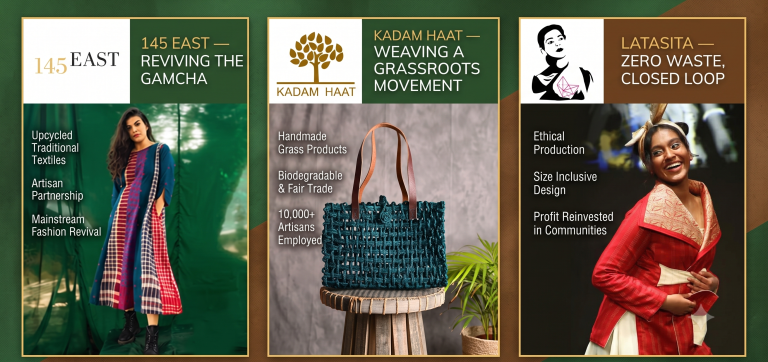
While sustainability has become a global conversation, three brands rooted in Eastern India’s cultural and artisan heritage have been living that philosophy long before it became a trend. 145 East, Kadam Haat, and LataSita are each building something distinct — but share a common conviction that commerce can have a conscience.
145 East — Reviving the Gamcha, One Drape at a Time
Kolkata-based 145 East began almost accidentally — helping two unemployed gamcha weavers raise funds through an NGO. That small act of solidarity became a full-fledged fashion collective, formally launched at The India Story 2016. The brand’s premise is simple but powerful: the gamcha, a humble household textile deeply embedded in Eastern Indian daily life, deserves to reclaim its place in mainstream fashion.
145 East works directly with weaving communities across Bengal and Odisha, where gamcha weaving is the primary economic driver for entire families. Their product range spans gamcha saris, dhoti bottoms, and upcycled clothing — all produced consciously with artisans who are treated as creative partners rather than suppliers. The brand’s philosophy of upcycling positions it not just as a fashion label but as a cultural revival project, pushing back against the western fast fashion habit of cheap, short-lived clothing that has no place in India’s textile history.
Kadam Haat — 10,000 Artisans, 10 Million Homes
Founded by Payal Nath — honoured as one of 75 Women Transforming India by NITI Aayog and recognised as an Iconic World Leader by the World Economic Forum — Kadam Haat brings 20 years of artisan network building to its mission. The brand works with over 10,000 trained artisans across rural West Bengal, Odisha, Bihar, and Kashmir, producing natural fibre-based home decor, dining, and lifestyle products made entirely from ingenious grasses grown across India.
Every product is 100 percent biodegradable and REACH compliant — meaning each piece actively contributes positively to the environment rather than simply avoiding harm. Kadam Haat is certified by the Fair Trade Forum, CraftMark, and GoodMarket, and its stated mission is to empower one million artisans with contemporary design knowledge and international product development skills. The brand’s ambition to reach 10 million Indian homes with natural fibre products makes it one of Eastern India’s most ambitious sustainable retail plays.
LataSita — Closed Loop, Zero Waste, Size Friendly
LataSita operates on a philosophy that cuts to the heart of what sustainable fashion should mean: closed loop production, zero waste, and genuine size inclusivity. The Kolkata-based label believes that social enterprise is the new wave of business with a conscience — where profit is simultaneously monetary, social, and environmental, and all surplus is returned to its projects or the communities it serves.
LataSita produces clothing described simply as beautiful clothes for beautiful people, designed to transition consumers away from disposable fashion toward garments that are made to last, made ethically, and made for real bodies. The brand is currently building its early access community, signalling an expansion phase ahead.
Why This Matters ?
What connects these three brands is not just their commitment to sustainability but their insistence that Eastern India’s craft traditions, artisan communities, and textile heritage are not relics — they are competitive advantages. In a retail landscape dominated by fast fashion and mass production, 145 East, Kadam Haat, and LataSita are proof that the most forward-looking brands in the region are also the ones looking deepest into its roots.
Sources: East India Retail, Kadam Haat official website (kadamhaat.com), LataSita official website (latasita.in).