Executive Summary: Durga Puja is West Bengal’s largest working-capital event. In roughly 45 days, retailers, artisans, and brands compress what British Council India’s benchmark study once valued at ₹32,377 crore (2.58% of GSDP) into a liquidity spike now estimated by CWBTA and BCC&I at ₹60,000–65,000 crore, with Kolkata contributing nearly 70% of transactions. This is less a festival than a seasonal economy with its own cash cycle, inventory risk, and media market.
Where the Money Flows
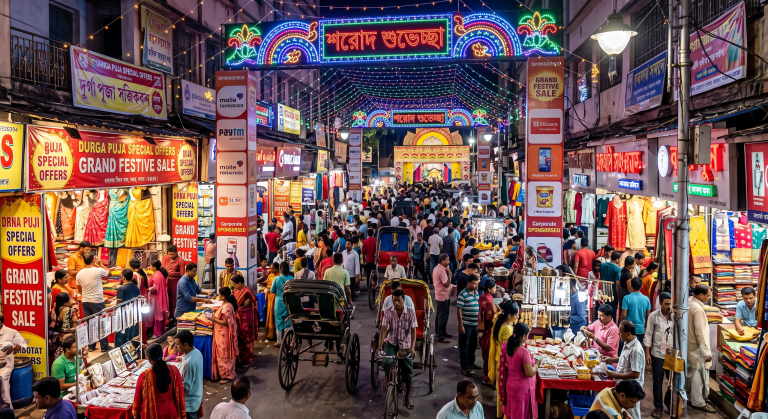
Retail and consumer discretionary — apparel, jewellery, electronics — account for over 80% of spend. Food and beverage takes roughly 7–8%. The remainder splits across outdoor media, sponsorship, and pandal construction (marquees, lighting, décor), a segment with outsized visibility relative to its wallet share.
The Retailer’s Gamble
- Lead time: Apparel and textile brands begin sourcing and production 4–5 months ahead, financed largely through short-term working capital loans against projected festive demand.
- Revenue concentration: Many regional apparel and jewellery retailers book 35–45% of annual revenue in this single window — a bet with no mid-course correction.
- Markdown risk: Unsold stock post-Dashami gets absorbed into end-of-season and Diwali clearance sales, compressing margins retailers had budgeted to protect.
Pandals as Marketing Real Estate
FMCG, fintech, auto, and lifestyle brands now treat large community pujas as media inventory — bidding for naming rights, entry-arch branding, and experiential activation zones. Sponsorship spend has effectively become a parallel outdoor-advertising market, priced on footfall rather than reach metrics.
The Informal Backbone
Kumartuli’s idol-makers and Chandannagar’s lighting artisans operate on thin, seasonal unit economics. Rising input costs — bamboo, clay, copper wire — squeeze margins even as corporate sponsorship budgets expand elsewhere in the ecosystem. Wage precarity remains structural: most labour is contracted for the season, with no off-cycle income floor.
The Q-Commerce Incursion
Quick-commerce dark stores and e-commerce festive sales are pulling last-mile, impulse, and gifting purchases away from high-street clusters like Gariahat and Hatibagan, compressing footfall-dependent revenue for street retailers even as overall category spend grows.
The Verdict
The data supports a hybrid conclusion: Durga Puja generates genuine multiplier effects — employment, informal-sector income, tourism, transit demand — but the bulk of value remains a concentrated, time-boxed consumption surge rather than a sustained annual driver of GSDP growth. The economy scales every year; the underlying structure — informal, seasonal, high-risk for retailers — has not changed.
Sources: British Council India, Mapping the Creative Economy around Durga Puja (₹32,377 crore, 2.58% of GSDP, 2019); CWBTA and BCC&I trade assessments.PRS Legislative Research (West Bengal GSDP); Retailers Association of India (festive retail data); Kolkata Metro ridership figures.
Sector-split percentages (retail 80–85%, F&B 7–8%) come from PTI-reported stakeholder estimates via Business Today/Business Standard.